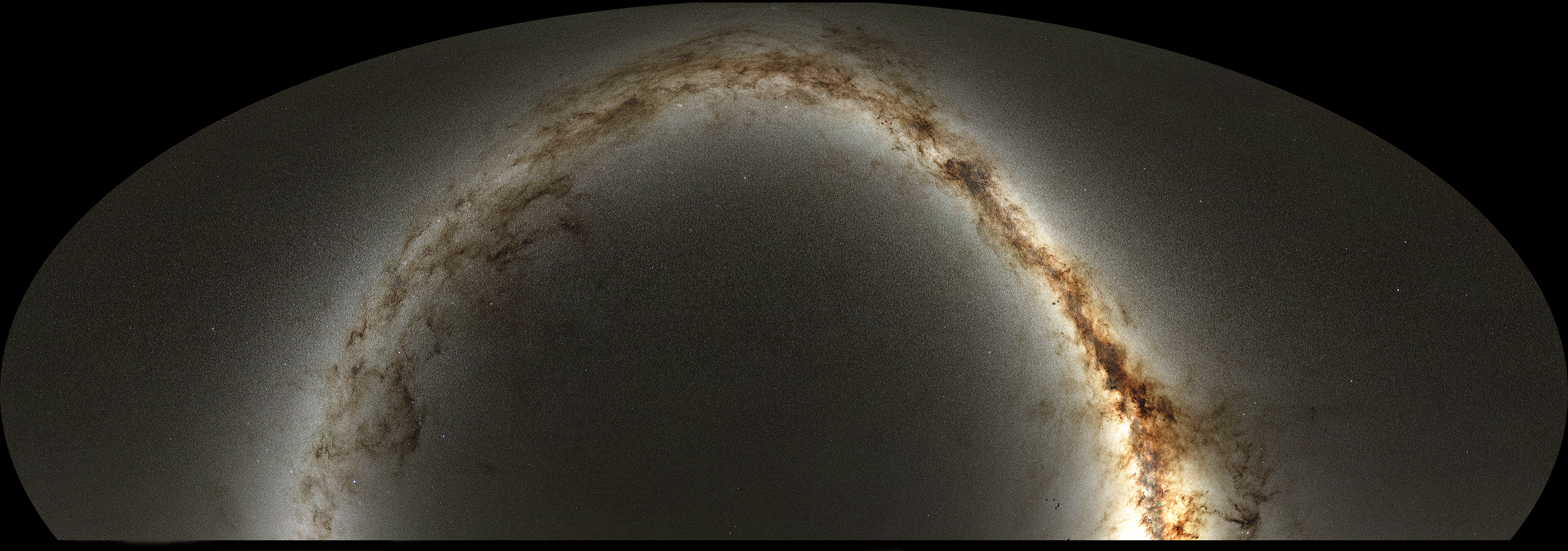
During the PS1SC Survey (2010 - 2014), the biggest fraction of the time (56%) went to the 3π Survey in which PS1 repeatedly observed most of the sky visible from Hawaii. By the end of the 4 year mission, each spot had been observed between 10 and 20 times in each of the five filters. After survey operations completed, the full 3pi dataset was reprocessed with up-to-date algorithms to produce a catalog of properties of astronomical objects.
In December 2019, data from the 3pi survey was first released to the general public via MAST, the Mikulski Archive for Space Telescopes the at the Space Telescope Science Institute (STScI) in Baltimore Maryland. This was followed by the second data release (DR2) in January 2019, extending DR1 by incorportating time-resolved photometry and individual exposures images.
Deep g,r,i images from the 3pi survey were combined to generate this full-color image of the entire 3pi sky (thanks to Danny Farrow, MPE).

C/2011 L4 (PANSTARRS) on Haleakala, Maui, on the night of June 5-6, it was confirmed to be a comet by UH astronomer Richard Wainscoat and graduate student Marco Micheli the following night using the Canada-France-Hawaii Telescope on Mauna Kea.
The comet was found while searching the sky for potentially hazardous asteroids -- ones that may someday hit Earth. Software engineer Larry Denneau, with help from Wainscoat and astronomers Robert Jedicke, Mikael Granvik and Tommy Grav, designed software that searches each image taken by the Pan-STARRS 1 telescope for moving objects. Denneau, Hsieh and UH astronomer Jan Kleyna also wrote other software that searches the moving objects for comets' tell-tale fuzzy appearance. The comet was identified by this automated software.

On October 19, 2017, astronomers at the University of Hawaii's Institute for Astronomy (IfA) made a stunning discovery with the Pan-STARRS1 telescope - the first interstellar object seen passing through our Solar System. The image shows an artist's impression of the object, 1I/2017 U1 (`Oumuamua).