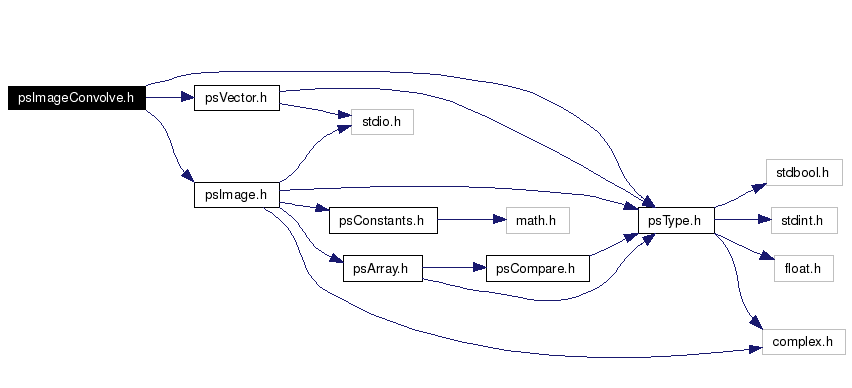
Definition in file psImageConvolve.h.
#include "psImage.h"
#include "psVector.h"
#include "psType.h"
Include dependency graph for psImageConvolve.h:
This graph shows which files directly or indirectly include this file:

Go to the source code of this file.
Defines | |
| #define | PS_TYPE_KERNEL PS_TYPE_F32 |
| the data member to use for kernel image | |
| #define | PS_TYPE_KERNEL_DATA F32 |
| the data member to use for kernel image | |
| #define | PS_TYPE_KERNEL_NAME "psF32" |
| the data type for kernel as a string | |
Functions | |
| psKernel * | psKernelAlloc (int xMin, int xMax, int yMin, int yMax) |
| Allocates a convolution kernel of the given range. | |
| bool | psMemCheckKernel (psPtr ptr) |
| Checks the type of a particular pointer. | |
| psKernel * | psKernelGenerate (const psVector *tShifts, const psVector *xShifts, const psVector *yShifts, bool relative) |
| Generates a kernel given a list of shift values. | |
| psImage * | psImageConvolve (psImage *out, const psImage *in, const psKernel *kernel, bool direct) |
| convolve an image with a kernel | |
| void | psImageSmooth (psImage *image, double sigma, double Nsigma) |
| Smooths an image by parts using 1D Gaussian independently in x and y. | |
|
|
the data member to use for kernel image
Definition at line 22 of file psImageConvolve.h. |
|
|
the data member to use for kernel image
Definition at line 23 of file psImageConvolve.h. |
|
|
the data type for kernel as a string
Definition at line 24 of file psImageConvolve.h. |
|
||||||||||||||||||||
|
convolve an image with a kernel Given an input image and the convolution kernel, psImageConvolve shall convolve the input image, in, with the kernel, kernel and return the convolved image, out. Two methods shall be available for the convolution: if direct is true, then the convolution shall be performed in real space (appropriate for small kernels); otherwise, the convolution shall be performed using Fast Fourier Transforms (FFTs; appropriate for larger kernels). The latter option involves padding the input image, copying the kernel into an image of the same size as the padded input image, performing an FFT on each, multiplying the FFTs, and performing an inverse FFT before trimming the image back to the original size.
|
|
||||||||||||||||
|
Smooths an image by parts using 1D Gaussian independently in x and y. Applies a circularly symmetric Gaussian smoothing first in x and then in y directions with just a vector. This process is 2N faster than 2D convolutions (in general).
|
|
||||||||||||||||||||
|
Allocates a convolution kernel of the given range. In order to perform a convolution, we need to define the convolution kernel. We need a more general object than a psImage so that we can incorporate the offset from the (0, 0) pixel to the (0, 0) value of the kernel. It might be convenient to allow both positive and negative indices to convey the positive and negative shifts. One might consider setting the x0 and y0 members of a psImage to the appropriate offsets, but this is not the purpose of these members, and doing so may affect the behavior of other psImage operations. This construction allows the kernel member to use negative indices, while preserving the location of psMemBlocks relative to allocated memory. The maximum extent of the kernel shifts shall be defined by the xMin, xMax, yMin and yMax members. Note that xMin and yMin, under normal circumstances, should be negative numbers. That is, myKernel->kernel[-3][-2] may be defined if yMin and xMin are equal to or more negative than -3 and -2, respectively. In the event that one of the minimum values is greater than the corresponding maximum value, the function shall generate a warning, and the offending values shall be exchanged.
|
|
||||||||||||||||||||
|
Generates a kernel given a list of shift values. Given a list of values (e.g., shifts made in the course of OT guiding), psKernelGenerate shall return the appropriate kernel. The vectors xShifts and yShifts, which are a list of shifts relative to some starting point, will be supplied by the user. The elements of the vectors should be of an integer type; otherwise the values shall be truncated to integers. The output kernel shall be normalized such that the sum over the kernel is unity. If the vectors are not of the same number of elements, then the function shall generate a warning shall be generated, following which, the longer vector trimmed to the length of the shorter, and the function shall continue.
|
|
|
Checks the type of a particular pointer. Uses the appropriate deallocation function in psMemBlock to check the ptr datatype.
|
 1.4.2
1.4.2